


Half the information an agent needs to do good work isn’t in the corpus. It’s in your head: intent, preferences, constraints you haven’t written down.
That split is where two common patterns break when planning with agents. Read-only approaches lean on the corpus and produce a competent average of it. Generic “what do you want?” interviews lean on you, but can’t draw out the in-your-head half because nothing concrete is steering the questions. Neither alone produces the artifact you actually want.
The fix is to do both, in sequence, and let the corpus shape the interview. Recent work on underspecified software tasks found that interactivity alone recovers up to 74% of the performance lost when inputs are vague. The corpus is what makes that interactivity sharp enough to actually draw clarity out of you. Generic interrogation doesn’t.
A handful of skills in, I noticed they all shared the same shape: grounded in a corpus, ask a few sharp questions, then act. I’ve been calling it the Anchored Interview Pattern.
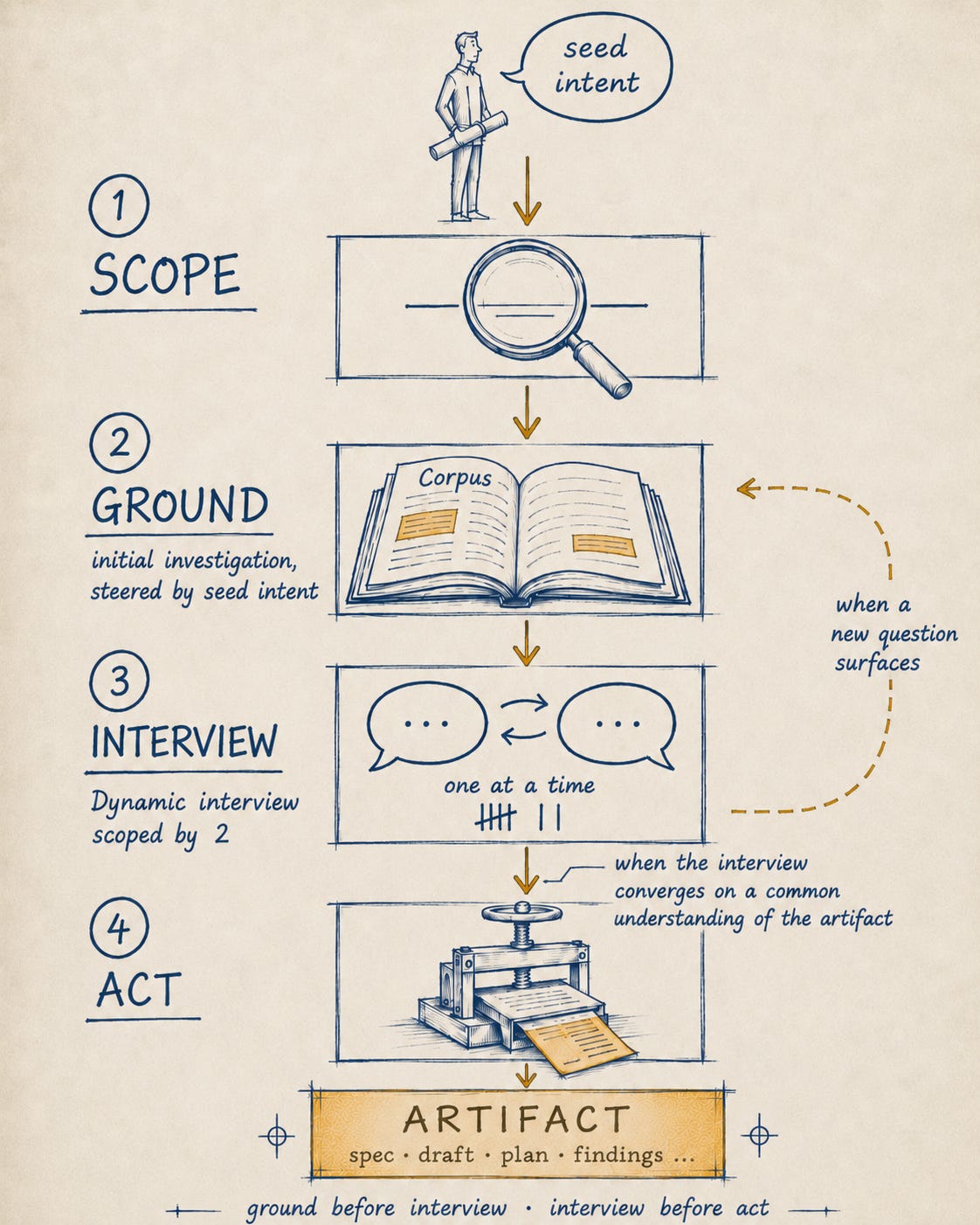
Two arrows in the diagram do real work. Step 3 loops back to the corpus. The interview isn’t one-shot; when an answer raises a new question, the agent re-grounds before continuing. And step 4 only fires once the interview converges on a shared picture of the artifact, agent and user aligned. The seed steers the grounding; the grounding sharpens the questions; the questions tighten the artifact.
I’d been writing these by hand for a while. A feature-spec skill that reads the project’s docs and source, then asks anchored questions like “I see existing API endpoints return 204 on success. Should this feature follow the same seam, or do you need payloads returned?”
The invariant is grounding before the interview; what varies is where the corpus comes from. Sometimes it already exists: a codebase, a docs site, a repo’s git history. Sometimes the agent needs to build it on the fly through online search before the interview begins. Same move either way. The questions get sharper because something concrete preceded them. Once you see the split, you’ll start spotting it in your own work, anywhere the answer the agent really needs is in your head, not in the corpus.
A converging signal worth noting. Martin Fowler recently sketched a related move he calls the Interrogatory LLM: the LLM interviews you to build the context document, one question at a time. Same impulse, and worth reading. The Anchored Interview adds the constraint that sharpens it: ground first, then interview.
A few things this is not. Not RAG, at least not the way it usually gets framed. No vector DB, no indexed corpus, no retrieval pipeline. It is context retrieval, but built on the fly rather than ahead of time. Not “ask the user what they want” either. That’s the thing the pattern fixes. And not “have the agent read your code.” Reading without an interview produces a competent average of the corpus. The interview is where the value lands.
The pattern produced its own producer. Once the shape was clear, I built one more skill (anchored-interview-skill-creator) that runs the pattern on itself. Its CORPUS is a bundled worked-example skill (the feature-spec one above); its ARTIFACT is a new skill directory. Give it a seed; a few questions later you have a new skill in ~/.claude/skills/. Here’s the test I ran:
/anchored-interview-skill-creator i need a skill for doing research
over a directory of documents and creating a draft of an essay
After just a few clarifying questions from the agent, it landed with this:
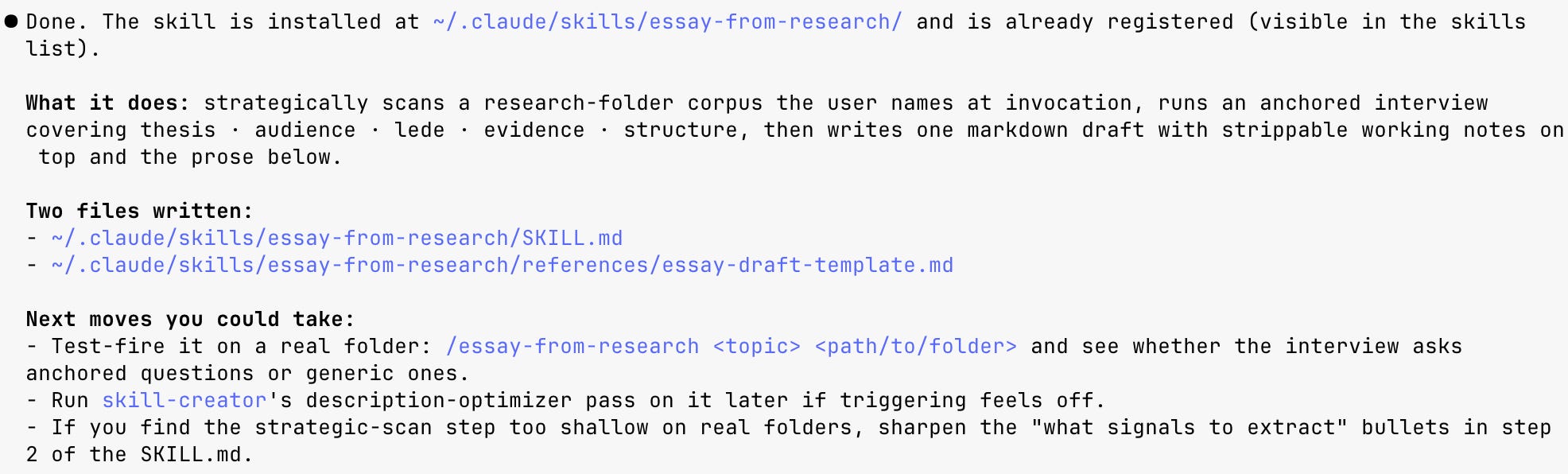
The produced skill does a strategic, seed-steered scan of the directory, surfaces the candidate theses the material actually supports, and pushes the writer to commit to an angle the sources will carry, before any prose gets written. Two of the question patterns it’s built to ask, paraphrased:
- "Your thesis is X, but the strongest source argues Y. Are we
   writing against that source, or is the thesis closer to Y than
   I'm reading?"
- "Source A and Source B disagree on point X. Which way does the
   essay come down?"
Two takeaways. Spot one this week. Look for the workflows where the answer the agent needs is in your head, not the corpus. Each one is an Anchored Interview waiting to be written. And: the shape is portable. It scales down to its own producer. A lot of underperforming skills want this exact upgrade. Including, as it turns out, the skill that creates the upgrade.
The skill to create Anchored Interview Skills is installable as a plugin if you’d like to try it: ac-anchored-interview-creator.